Gossip Analytics vs Cognitive3D: From Spatial Data to AI-Driven Decisions
By Daniel Sánchez, Co-founder of Gossip Analytics
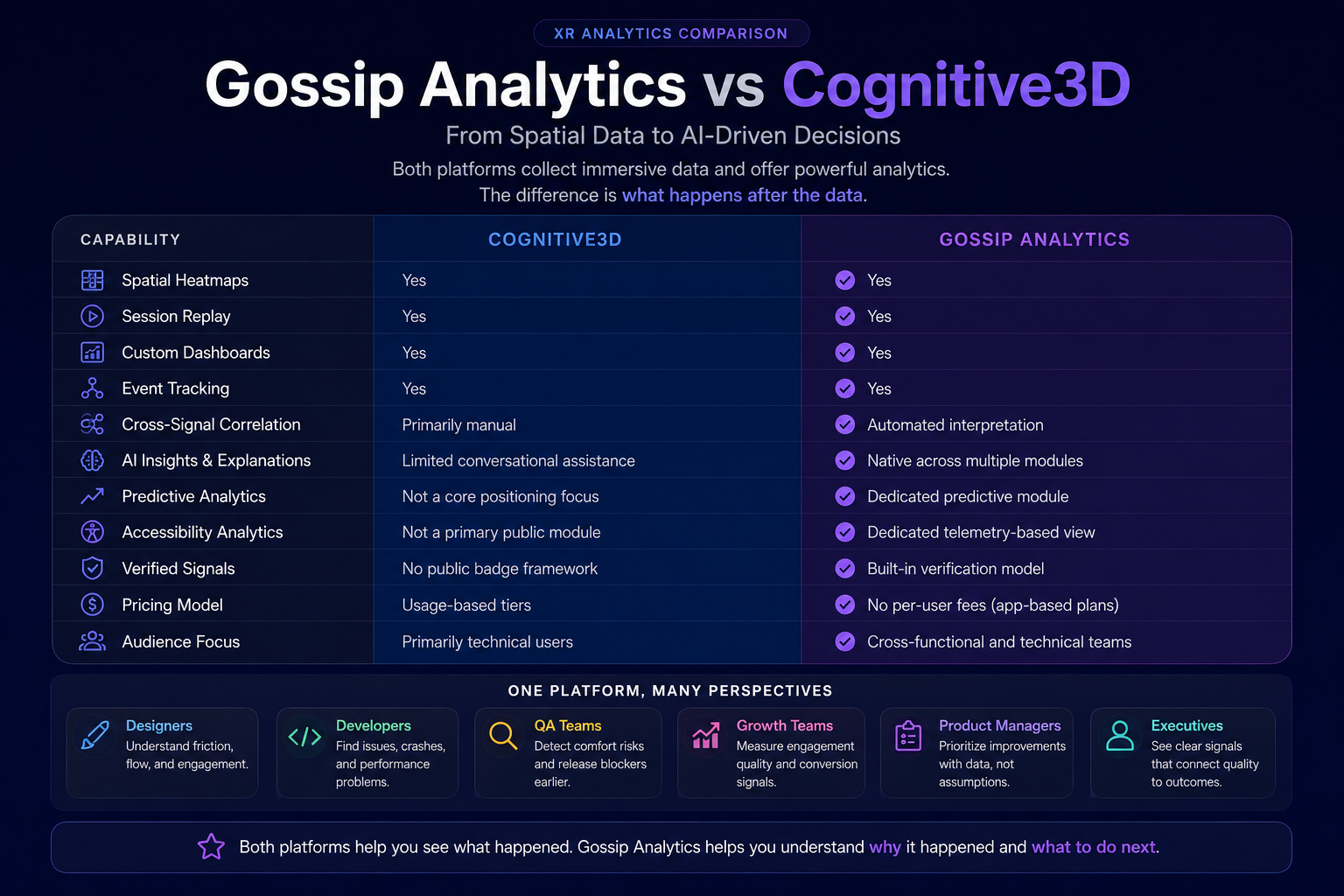
The core difference: Cognitive3D is built for teams that want to investigate immersive telemetry in depth themselves, while Gossip Analytics is built for cross-functional teams that want that same spatial data interpreted automatically into prioritized next actions.
Cognitive3D is the better fit when analysts want full manual control over exploration; Gossip Analytics is the better fit when design, product, QA and engineering need to share one interpretation and act on it without per-user pricing.
XR teams no longer struggle to collect data. They struggle to interpret it.
Modern immersive applications generate an enormous amount of telemetry:
- Movement and spatial behavior
- Gaze and attention patterns
- Hand and controller interactions
- Comfort and presence signals
- Crashes and technical issues
- Accessibility indicators
- Emotional responses
- Version-by-version changes
The real challenge is not seeing this information. The real challenge is understanding what matters and deciding what to do next.
That is where the difference between Cognitive3D and Gossip Analytics becomes meaningful.
Two Valid Approaches to XR Analytics
Both platforms are built to help teams understand immersive experiences. Both provide spatial analytics, heatmaps, session replay, custom dashboards, event tracking and technical instrumentation.
Both are capable products. The difference lies in what happens after the data is collected.
Cognitive3D helps teams investigate immersive behavior. Gossip Analytics is designed to explain what happened and prioritize what to do next.
The Hidden Cost of Analytics
Most teams underestimate the time required to interpret analytics. Even with strong dashboards, someone still needs to:
- Detect the anomaly.
- Connect related signals.
- Determine severity.
- Identify probable causes.
- Recommend actions.
- Communicate findings to stakeholders.
This cognitive work often consumes more time than fixing the underlying issue. The bottleneck is no longer instrumentation. The bottleneck is interpretation.
What Cognitive3D Does Well
Cognitive3D is one of the most established platforms in immersive analytics. It offers mature capabilities for spatial exploration, user journey analysis, session replay, custom dashboards and data export and investigation. For teams that want to analyze raw immersive telemetry in depth, it is a strong solution.
What Gossip Analytics Adds
Gossip Analytics builds on the same analytical foundation and adds an embedded intelligence layer. Instead of requiring teams to manually connect signals, the platform helps interpret them automatically. Examples include:
- AI explanations for crashes and issues
- Emotional summaries across sessions
- Predictive analytics based on historical trends
- Accessibility insights from telemetry
- Verified Signals that convert metrics into evidence-backed badges
The goal is to shorten the time between observation and decision.
Analytics That Speak to More Than Developers
Most analytics tools are primarily used by technical users. Gossip Analytics is designed so that designers, product managers, QA teams, growth teams and executives can understand the same signals without translating complex dashboards into separate reports. This does not replace technical depth. It reduces the communication gap between disciplines.
The Core Difference
Cognitive3D — A mature spatial analytics platform for capturing, replaying and investigating XR behavior.
Gossip Analytics — An AI-first analytics platform designed to interpret connected signals, surface likely drivers and prioritize what the team should investigate or improve next.
Both can show that users abandon a scene. Both can display heatmaps and replay sessions. Gossip Analytics connects spatial, technical, comfort, accessibility and behavioral signals to surface likely explanations and prioritize the next action.
From Behavior Analysis to Spatial Decision Intelligence
Both platforms help teams examine immersive behavior. Gossip Analytics places its primary differentiation in what happens after a pattern is detected.
- Behavior: Movement, gaze, interaction, hesitation and task progression.
- Signals: Recurring or abnormal patterns found across sessions.
- Insights: Evidence-linked explanations of what may be affecting the experience.
- Decisions: Prioritized actions that can be tested in the next iteration.
Explanations are stated as likely drivers, not confirmed causes; the supporting signals stay visible so the team can validate them. See the Behavior → Signals → Insights → Decisions framework for the full walkthrough.
This is the operational focus of Spatial Decision Intelligence: shortening the path from immersive behavior to a defensible product decision.
Side-by-Side Comparison
| Feature | Gossip Analytics | Cognitive3D |
|---|---|---|
| Spatial Heatmaps | Yes | Yes |
| AI-Interpreted Signals | Embedded intelligence layer and automatic interpretation | — |
| Comfort and Ergonomics Signals | Comfort and presence signals | — |
| Session Replay | Yes | Yes |
| Supported Engines and Platforms | Unity, Unreal, WebXR, Meta Horizon OS, Android XR, visionOS | — |
| Pricing Model | Fixed plans, app-based expansion, no per-user fees | Usage-based tiers |
| Privacy-First Design | Privacy-first architecture; no raw audio recording | — |
| Target Teams | Design, product, UX research, QA, growth and engineering | Primarily technical users |
| Primary Value | Understand why and prioritize next actions | Investigate what happened |
From Metrics to Verified Evidence
One of the most distinctive concepts in Gossip Analytics is the Verified Signals framework. Instead of leaving metrics as isolated numbers, the platform can translate sustained performance into evidence-backed badges such as Verified Stability Signal, Verified Comfort Signal and Verified Spatial UX Signal. This makes quality visible and easier to communicate across engineering, UX and leadership teams.
Pricing Philosophy
Pricing affects product decisions. Many analytics platforms scale with usage. Gossip Analytics is positioned around fixed plans and app-based expansion, without per-user fees. This model aims to let teams grow adoption without tying costs directly to user volume.
Which Platform Fits Your Team?
Choose Cognitive3D if:
- Your primary need is deep manual exploration.
- Your analysts are comfortable connecting signals themselves.
- You prefer an established investigation-oriented workflow.
Choose Gossip Analytics if:
- You want analytics that help prioritize actions.
- You want AI embedded directly into the workflow.
- You need predictive and cross-signal interpretation.
- You want insights that are easier to share across multiple disciplines.
The Real Question
The most important question is not “Which platform has more charts?” The more useful question is: How quickly can our team move from telemetry to confident action?
Final Perspective
Both Cognitive3D and Gossip Analytics provide serious XR analytics capabilities. The difference is operational philosophy. Cognitive3D emphasizes investigation. Gossip Analytics emphasizes interpretation and prioritization.
Both platforms help you see what happened. Gossip Analytics is built to connect the surrounding signals, surface likely explanations and prioritize what to do next.
Looking for a Cognitive3D Alternative?
Teams searching for a Cognitive3D alternative in 2026 are usually looking for three things: an AI layer that interprets spatial behavior instead of just visualizing it, a VR analytics platform that fits more than just engineering teams, and a pricing model that does not punish growth. Gossip Analytics is built around those three expectations.
On capability, Gossip Analytics matches the core features that make Cognitive3D a credible choice — spatial heatmaps, session replay, custom dashboards, event tracking, and Unity, Unreal, WebXR, Meta Quest and visionOS coverage. On top of that, the AI decision layer correlates comfort, accessibility and stability signals so product, UX and research teams get prescriptive next steps rather than another dashboard to triage.
On Cognitive3D pricing, the most common friction is usage-based tiers that scale with sessions and seats. Gossip Analytics uses fixed plans with app-based expansion and no per-user fees, so a VR analytics platform rollout does not become a budgeting risk when adoption grows. That makes Gossip Analytics a natural Cognitive3D alternative for studios, training providers, and enterprise XR teams planning multi-year programs.
Frequently asked questions
Ready to Compare in Practice?
Explore how Gossip Analytics turns immersive telemetry into actionable intelligence.
Compare with your setup