We Are Not Another Tab in Power BI
Why growth leaders are tired of dashboards, and why immersive analytics has to start driving decisions instead of adding yet another tab of views.
Editorial review: Reviewed for technical accuracy and analytical soundness by the Gossip Analytics editorial team before publication. Published and updated dates above reflect substantive edits. Meet the authors.
Methodology: Written from applied XR product work and aggregated behavior patterns. Where a scenario is illustrative rather than measured, it is labelled in the text. No raw audio, personally identifying data or named customer deployments are used.
Related reading: XR analytics glossary · What is XR analytics · Case studies
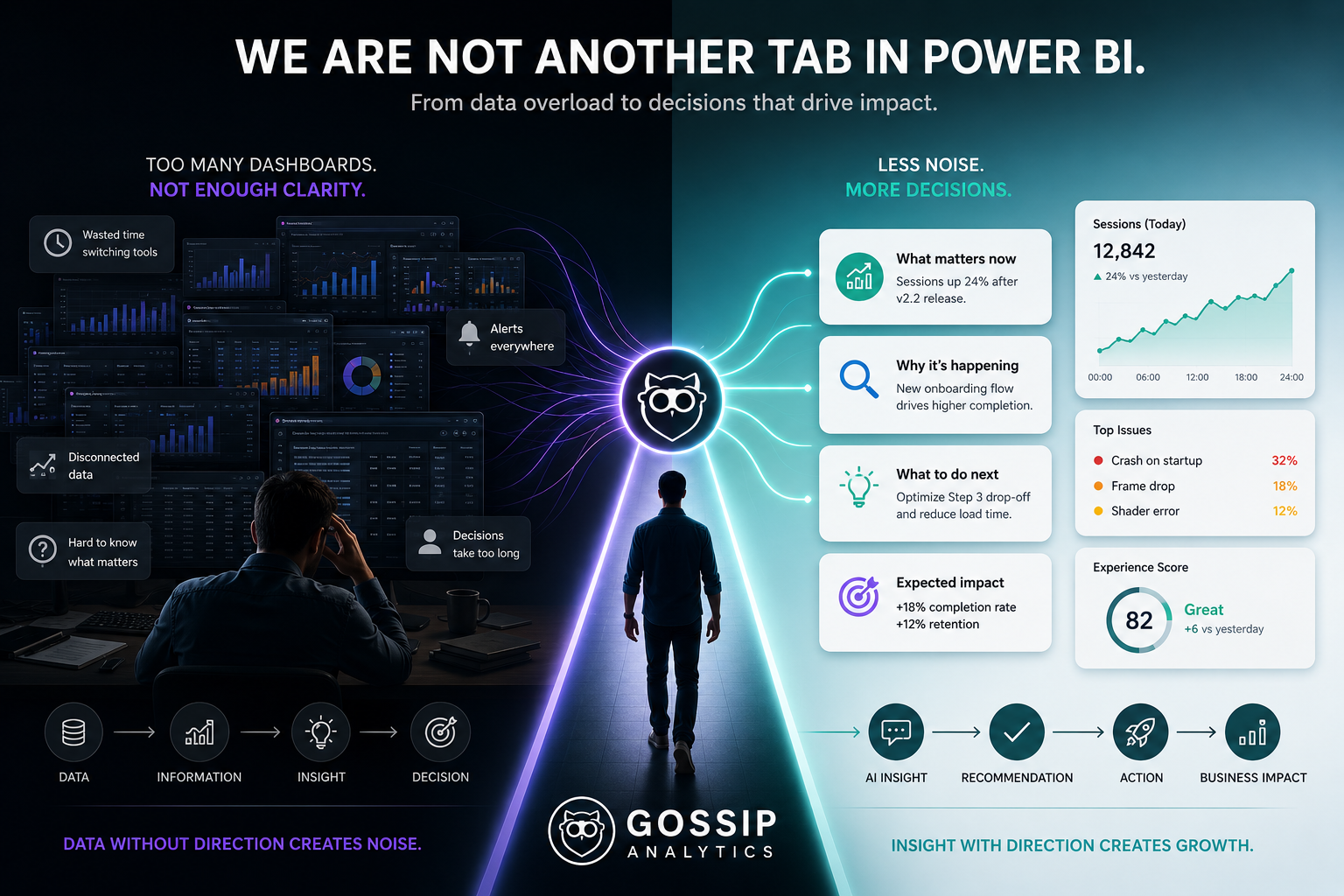
There is a growing tension inside modern organizations.
Every team wants better visibility.
Every platform promises deeper analytics.
Every new integration adds more data.
And yet, many growth and business leaders are asking a simple question:
Are we making better decisions, or just opening more dashboards?
This concern is becoming increasingly common among revenue, growth, and product executives.
The issue is not access to data.
The issue is decision overload.
What Changes When the Data Is Behavior
Business intelligence tools are effective at organizing known metrics. XR introduces a different problem: the source material is continuous human behavior occurring across space, time, devices and physical movement.
A path, gaze point or interaction event does not explain itself. Teams still need to determine whether a pattern represents confusion, an unclear affordance, technical degradation, discomfort or expected behavior.
Behavior → Signals → Insights → Decisions
Gossip Analytics approaches this as a decision pipeline. It captures observable behavior, derives meaningful signals, connects those signals to contextual explanations and recommends a testable next action. When enough history exists, recurring patterns can also be used to flag likely drivers earlier, framed as possible explanations rather than confirmed causes.
The difference is not whether a dashboard contains AI. The difference is whether the system reduces the analytical work required between seeing a pattern and deciding what to do next.
A generalist BI platform is not deficient here; it simply does not natively model spatial and behavioral context. That interpretation layer has to exist somewhere, and in XR it belongs closer to the behavior itself. See the decision pipeline applied to immersive behavior.
Dashboard Fatigue Is Real
Most organizations already rely on a mature analytics stack.
Depending on the company, teams may work across:
- Power BI
- Tableau
- Looker
- Google Analytics
- CRM reporting
- Product analytics platforms
- Internal dashboards
Each tool serves a purpose.
Together, they often create a new problem.
Too many places to look. Too many metrics to interpret. Too many reports to maintain.
The result is a form of operational friction commonly described as dashboard fatigue.
Teams spend more time reviewing information than acting on it.
The Promise of BI Integration
Many analytics vendors now position integrations with business intelligence tools as a strategic advantage.
The logic is sound.
Instead of forcing teams to log into a specialized platform, data is delivered into environments where leaders already work.
This makes it possible to combine domain-specific metrics with:
- Operational KPIs
- Learning data
- Revenue indicators
- Customer outcomes
From an enterprise perspective, this is useful and often necessary.
But integration alone does not solve the core problem.
More Data Does Not Automatically Produce Better Decisions
Business intelligence platforms are excellent at consolidating and visualizing information.
They help organizations:
- Aggregate data from multiple sources
- Build executive dashboards
- Track performance over time
What they do not inherently do is answer:
- What matters most right now?
- Why is this happening?
- What should the team do next?
- What action is likely to generate the highest impact?
Those answers still depend on human interpretation.
And interpretation remains one of the largest bottlenecks in analytics.
The Hidden Cost of Traditional Analytics
Most analytics systems stop at visibility.
They show charts, trends, anomalies, correlations.
But someone still has to:
- interpret what the signals mean,
- assess their importance,
- prioritize actions,
- coordinate decisions.
This manual effort creates delay and inconsistency.
The organization has data, but not necessarily clarity.
The Analytics Maturity Model
Analytics becomes valuable only when it progresses through six stages:
- Data
- Information
- Insight
- Decision
- Action
- Business impact
Many tools excel at the first two stages.
Some assist with insight generation.
The real business value appears only when insight is translated into action.
What Growth Leaders Actually Care About
Growth executives are generally not interested in collecting more reports.
They want to know:
- What is limiting performance?
- What opportunity has the highest upside?
- What should be prioritized first?
- What is the likely business impact?
In other words, they care about decision acceleration.
The most important KPI is not dashboards created.
It is decisions made.
From Data Pipelines to Decision Intelligence
A new category of analytics is emerging.
Instead of focusing solely on visualization and integration, these systems:
- detect meaningful patterns,
- explain findings in plain language,
- prioritize issues,
- recommend next steps,
- predict likely outcomes.
The objective is not simply to show information.
The objective is to reduce the time between signal and action.
We Are Not Another Tab in Power BI
This principle reflects a broader shift in analytics.
Organizations do not need more places to check.
They need systems that interpret complexity and surface what matters.
Some platforms specialize in exporting domain-specific data into BI environments.
Others go a step further by converting behavioral signals into concrete recommendations.
That distinction marks the transition from reporting to decision intelligence.
The Strategic Question Every Leader Should Ask
When evaluating any analytics platform, the most important question is:
Does this tool show me data, or does it help me decide what to do next?
The answer determines whether the platform becomes:
- another dashboard to monitor, or
- an operational intelligence system that drives action.
Final Thought
Business intelligence tools remain essential.
They organize information and create shared visibility across the enterprise.
But visibility alone does not change outcomes.
Analytics delivers real value only when it shortens the path from signal to decision.
Because data does not improve products.
Decisions do.
The future of immersive analytics is not another visualization layer. It is Spatial Decision Intelligence: a traceable system for turning immersive behavior into product decisions.
Want to apply this to your XR product?
Talk to our team and see how Predictive XR Analytics built on biomechanical patterns applies to your immersive product.
Next Decision
Continue your decision path
Compare platforms