From Issues to Evidence: Why XR Analytics Should Also Recognize What Works
XR analytics should not only detect crashes, friction and discomfort. Verified Signals turn immersive performance into evidence-backed recognition.
Editorial review: Reviewed for technical accuracy and analytical soundness by the Gossip Analytics editorial team before publication. Published and updated dates above reflect substantive edits. Meet the authors.
Methodology: Written from applied XR product work and aggregated behavior patterns. Where a scenario is illustrative rather than measured, it is labelled in the text. No raw audio, personally identifying data or named customer deployments are used.
Related reading: XR analytics glossary · What is XR analytics · Case studies

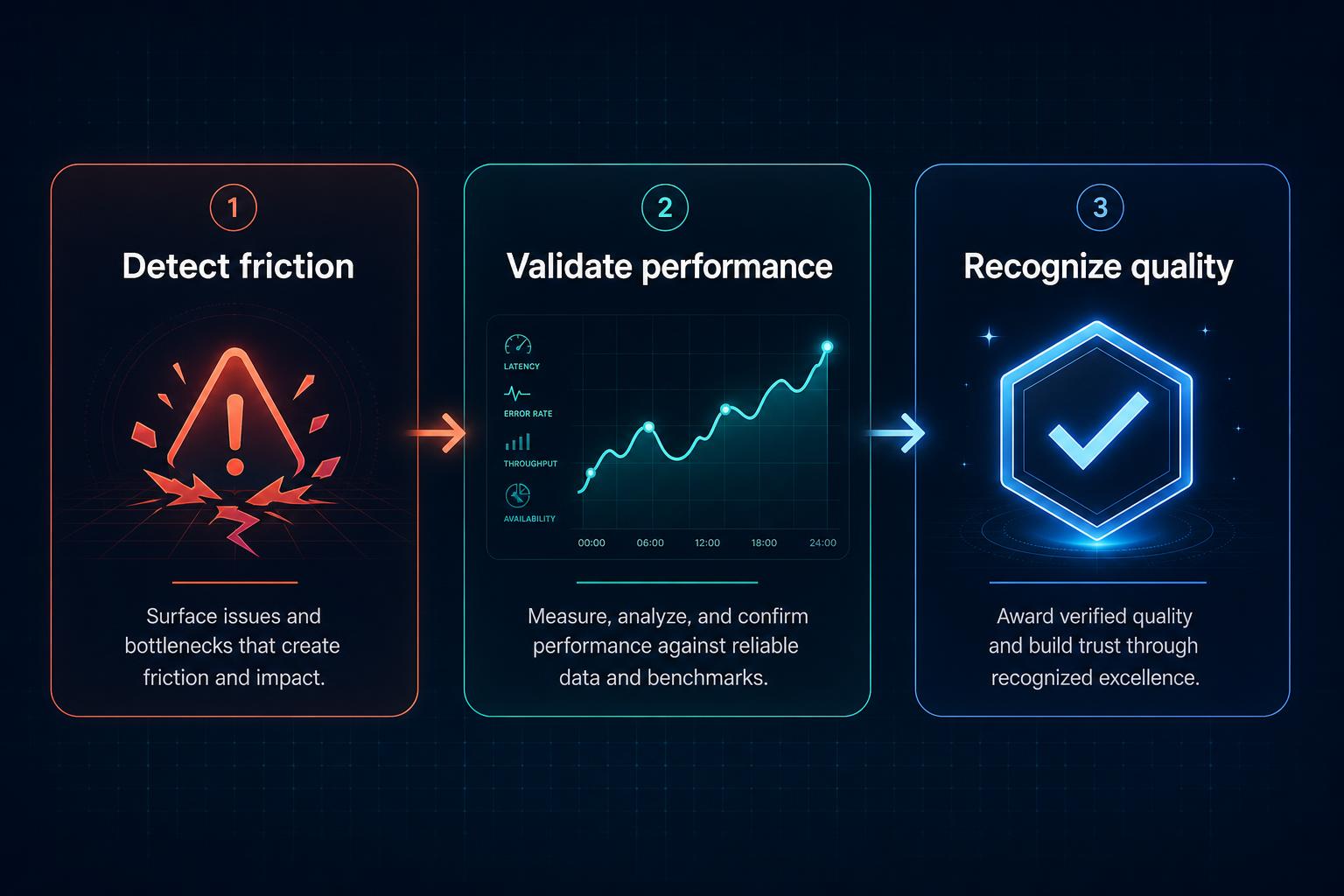
Most analytics tools are built to detect what went wrong.
Crashes. Drop-offs. Friction. Discomfort. Failed interactions.
That matters. Teams need to know where the experience breaks. They need to see what causes abandonment, where users get stuck and which parts of the system create unnecessary friction.
But that is only half of the story.
In immersive experiences, teams also need evidence of what is working.
A stable session is not just the absence of a crash. A comfortable interaction is not just the absence of a complaint. A clear spatial flow is not just a user reaching the end by accident.
Good XR work should leave evidence.
The Problem With Only Measuring Failure
When analytics focuses only on issues, teams get a distorted view of the product.
They learn what is broken, but not always what is strong.
That creates an operational gap. A product team may improve stability, reduce friction or make a training experience easier to complete, but if the analytics layer only highlights problems, that progress can remain invisible.
This is especially important in XR.
Immersive products are not only screens with clicks. They involve movement, space, attention, comfort, orientation, physical interaction and sometimes emotional response. Quality is not always captured by a single conversion event or a generic engagement metric.
In XR, "working well" needs its own evidence.
Recognition Is Not Gamification
Recognizing what works does not mean turning analytics into a game.
This is not about decorative badges, superficial rewards or empty achievement systems.
The point is not to make teams feel good.
The point is to make quality visible.
A meaningful recognition system should be based on real signals: stable sessions, reduced issue recurrence, smoother spatial flows, healthier comfort patterns, stronger completion behavior or better use of insights over time.
Recognition only matters when it is tied to evidence.
From Data to Proof
Product teams often rely on language like:
- "The new version feels better."
- "Users seem more comfortable."
- "The flow looks clearer now."
- "The training experience is more stable."
Those statements may be true. But they are stronger when supported by telemetry.
If a team improves a training simulation and users complete it with fewer interruptions, that improvement should be visible. If comfort-related friction decreases across sessions, that should be visible. If a spatial flow becomes clearer after iteration, that should be visible.
Analytics should help teams explain not only what failed, but what improved.
That is where evidence becomes useful beyond the dashboard.
What Should Be Recognized?
The first areas worth recognizing in XR are not abstract. They are practical and measurable.
Stability matters because users cannot trust an experience that repeatedly breaks.
Comfort matters because immersive environments affect the body, not just attention.
Spatial UX matters because users need to understand where to go, what to do and how to move through the experience without unnecessary friction.
These are not vanity signals. They are core indicators of whether an immersive experience is usable, reliable and ready to be taken seriously.
As analytics maturity grows, recognition can expand into more advanced areas: AI adoption, engagement quality, issue resolution, accessible interaction patterns, release-gated stability, multi-app quality and training impact.
But the principle stays the same:
Recognition should follow evidence, not marketing claims.
Why This Matters for XR Teams
For UX and product teams, recognizing what works helps translate design decisions into something stakeholders can understand.
For technical teams, it helps show that stability, issue resolution and release quality are improving over time.
For business teams, it creates a clearer way to communicate product quality without relying only on screenshots, demos or subjective feedback.
For XR training providers, it creates a path to demonstrate that the experiences they build are not only functional, but measurable.
That distinction matters.
A training app should not only look immersive. It should help users complete the intended experience with stability, clarity and reduced friction.
Recognition Should Be Hard to Earn
If everything gets recognized, nothing is meaningful.
A strong recognition system should not reward a single good session or a temporary spike. It should look for consistency across time, enough data to support the signal and the absence of critical blockers.
It should also be time-bound.
Products change. Versions change. Devices change. Training flows change. What worked six months ago may not hold today.
That means recognition should be maintained, not permanently assumed.
The idea is simple:
- Earn it through data.
- Keep it through consistency.
- Lose it if the experience no longer holds up.
What Recognition Should Not Claim
Telemetry-based recognition is not a replacement for formal audits, compliance reviews, expert evaluation or legal certification.
It should not claim that an experience is medically safe.
It should not claim legal accessibility compliance.
It should not claim WCAG certification.
It should not pretend that a badge alone proves everything.
A responsible recognition system should be clear about its limits. It can say:
"This experience shows strong telemetry-backed performance in this area."
It should not say:
"This experience is legally certified."
That difference is essential.
The Next Step for XR Analytics
The next step for XR analytics is not only better dashboards.
It is better evidence.
Teams need to know what broke, but they also need to know what held up. They need to understand where users struggled, but also where the experience supported them well. They need to identify friction, but also recognize quality when the data supports it.
Because analytics should not only create a list of problems.
It should help teams build confidence in what they are doing right.
Good XR work should leave evidence.
And when the evidence is strong enough, it should be recognized.
Want to apply this to your XR product?
Talk to our team and see how Predictive XR Analytics built on biomechanical patterns applies to your immersive product.
Next Decision
Continue your decision path
Compare platforms