Gossip Analytics vs XR Analytics Tools
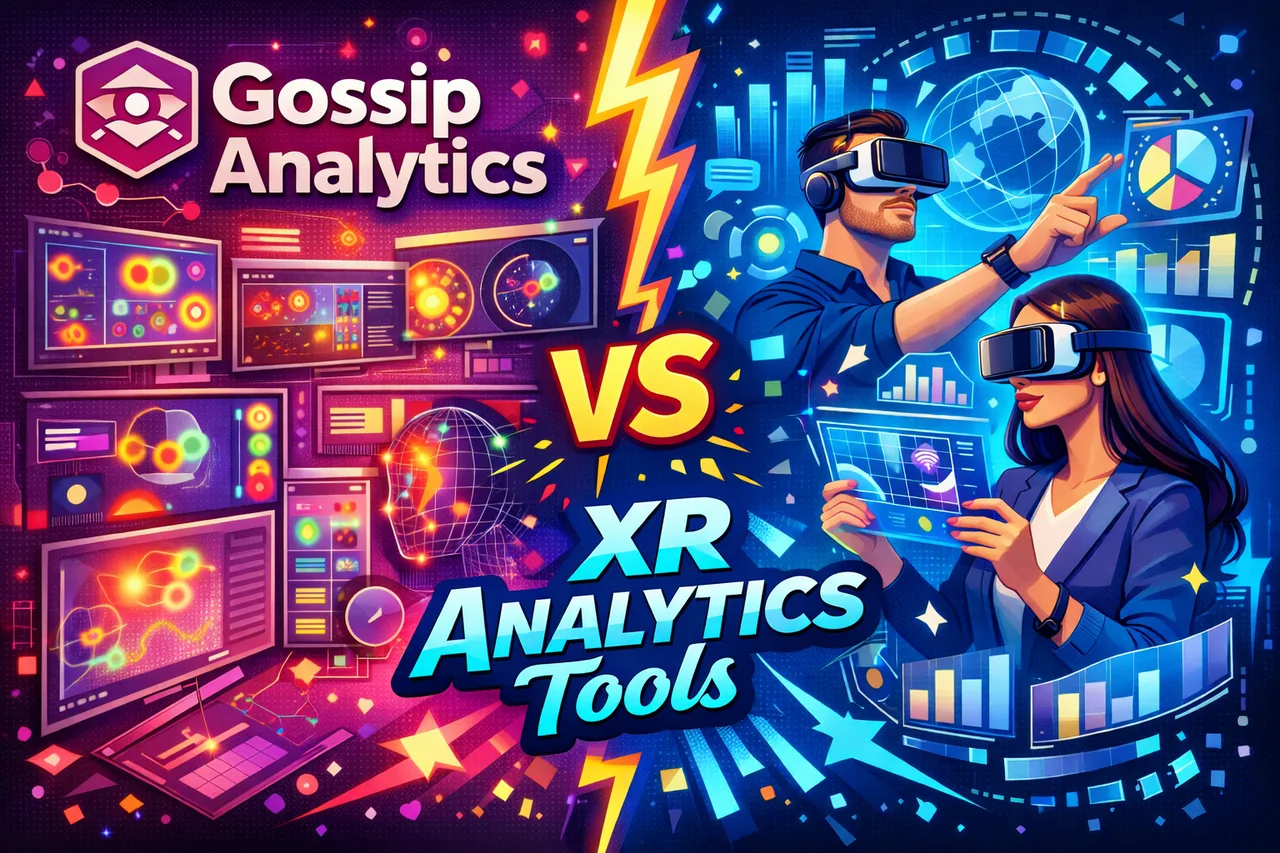
XR analytics tools aim to measure user behavior inside immersive and interactive environments, but they differ significantly in how they collect data, interpret signals and support decision-making.
This page provides a practical, non-promotional comparison of Gossip Analytics and other XR analytics tools, focusing on approach, capabilities and trade-offs — not marketing claims.
For a foundational explanation of the domain, see What is Immersive Analytics.
What Most XR Analytics Tools Have in Common
Most XR analytics platforms provide:
- SDK-based data collection,
- event and interaction tracking,
- basic spatial metrics,
- dashboards for exploration.
These tools are valuable for understanding what happens inside an experience.
The differences appear when teams need to understand why it happens.
Key Dimensions to Compare XR Analytics Tools
When evaluating XR analytics platforms, teams should focus on five core dimensions.
1. Data Model
Most XR analytics tools
- rely heavily on events and predefined metrics,
- treat spatial data as an extension of traditional analytics.
Gossip Analytics
- is built around spatial behavior as first-class data,
- prioritizes movement, gaze, proximity and interaction patterns,
- treats environments—not pages—as the primary unit of analysis.
To understand why this matters, see XR Analytics vs Traditional Analytics.
2. Interpretation vs Visualization
Most XR analytics tools
- focus on dashboards and raw visualizations,
- require manual exploration and expert interpretation.
Gossip Analytics
- applies AI-first analytics to interpret signals automatically,
- surfaces friction, confusion and behavioral patterns,
- translates data into clear visual narratives.
This interpretive approach is explained in AI-First Analytics: From Signals to Decisions.
3. Use of AI
Most XR analytics tools
- use AI for aggregation or anomaly detection,
- leave insight generation to human analysts.
Gossip Analytics
- embeds AI at the core of the analytics workflow,
- focuses on meaning, not just measurement,
- reduces cognitive load for design, product and data teams.
AI is used to support decisions, not to increase data volume.
4. Testing Environments and Versioning
Most XR analytics tools
- focus primarily on production data,
- offer limited support for environment isolation.
Gossip Analytics
- supports separate environments (development, staging and production),
- enables clean testing and comparison between versions,
- helps teams validate changes before full release.
This is particularly important for iterative XR and game development.
5. Pricing and Scalability
Most XR analytics tools
- charge per user, session or event volume,
- introduce variable costs as adoption grows,
- create friction for scaling.
Gossip Analytics
- avoids per-user pricing models,
- focuses on transparent subscription-based access,
- allows teams to scale usage without hidden penalties.
Pricing models affect not just cost, but how confidently teams can experiment.
Side-by-Side Comparison
| Dimension | Typical XR Analytics Tools | Gossip Analytics |
|---|---|---|
| Core data | Events + limited spatial data | Spatial behavior as core |
| Interpretation | Manual, dashboard-driven | AI-first, insight-driven |
| Focus | Measurement | Understanding |
| Environment support | Production-focused | Dev, staging and production |
| Pricing model | Per user or usage-based | Subscription-based |
| Decision support | Indirect | Direct and contextual |
When Gossip Analytics Is a Better Fit
Gossip Analytics is designed for teams that:
- work with XR, games or interactive 3D environments,
- need to understand behavior in space, not just events,
- want insights without heavy manual analysis,
- iterate frequently and test safely,
- value clarity, accessibility and scalability.
When Other Tools May Be Sufficient
Other XR analytics tools may be sufficient when:
- tracking basic interactions only,
- working with small-scale experiences,
- prioritizing event counts over behavioral insight.
Different tools serve different needs.
The key is choosing the right model for your experience.
How Gossip Analytics Fits Into the Analytics Stack
Gossip Analytics is not intended to replace all analytics tools.
It complements traditional analytics by:
- measuring spatial behavior,
- revealing friction invisible to event-based tools,
- supporting design, UX and strategic decisions.
To understand how behavior is measured in practice, see How to Measure User Behavior in XR & Games.
Choosing the Right XR Analytics Approach
The right XR analytics tool depends on:
- the nature of the experience,
- the maturity of the team,
- the decisions that need to be supported.
The goal is not more metrics.
The goal is better understanding.
Frequently asked questions
Related concepts
What is Immersive Analytics
The foundational concept behind XR analytics.
XR Analytics vs Traditional Analytics
Why immersive experiences require a different analytics model.
How to Measure User Behavior in XR & Games
Practical methods for understanding behavior in space.
AI-First Analytics: From Signals to Decisions
How AI transforms spatial signals into insights.