Meta VR Glasses expand what immersive analytics can understand
Meta VR Glasses expand eye, hand and spatial interaction while remaining within Meta's Quest and OpenXR ecosystem. See what this means for Gossip Analytics and immersive behavioral analytics.
Editorial review: Reviewed for technical accuracy and analytical soundness by the Gossip Analytics editorial team before publication. Published and updated dates above reflect substantive edits. Meet the authors.
Methodology: Written from applied XR product work and aggregated behavior patterns. Where a scenario is illustrative rather than measured, it is labelled in the text. No raw audio, personally identifying data or named customer deployments are used.
Related reading: XR analytics glossary · What is XR analytics · Case studies
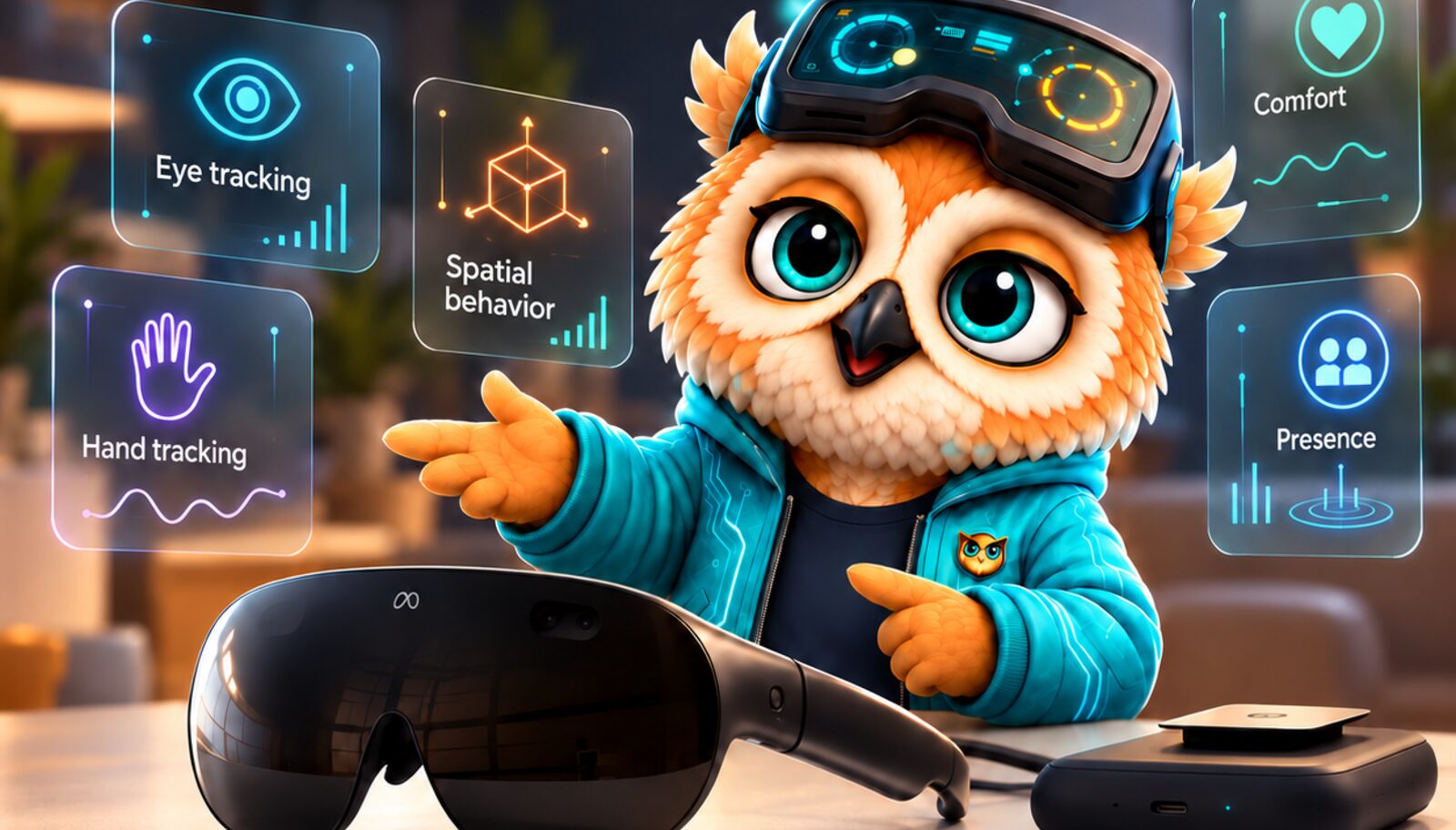
A new form factor, the same foundation — and a richer behavioral layer for XR analytics.
Meta introduced Meta VR Glasses at Connect 2026, a new lightweight mixed reality device scheduled for 2027.
At around 100 grams, the headset moves processing and battery components into an external compute puck while introducing eye-based navigation, natural hand gestures and a stronger focus on spatial computing, productivity, media and immersive experiences.
For Gossip Analytics, however, one of the most relevant parts of the announcement is not the hardware itself.
It is the continuity underneath it.
A new device without a new analytics architecture
Meta VR Glasses run within the existing Meta XR software ecosystem. The device uses the same operating system and store as Quest and supports the existing Quest content library.
That matters for an analytics platform built around Unity and OpenXR.
Meta's own developer documentation states that Horizon OS runtimes are OpenXR conformant and compatible with Unity's OpenXR Plugin. Meta also describes OpenXR as its standard API for new VR/XR development.
Gossip Analytics was designed around that same principle.
Our Unity SDK is OpenXR-first, rather than being tied to a single headset generation.
Meta VR Glasses therefore do not require us to create a separate analytics SDK or redesign our architecture around a completely new platform.
The foundation remains:
Unity → OpenXR → Gossip Analytics SDK → behavioral and spatial analytics
What changes is not the architecture.
What changes is the richness of the behavior that can be observed.
From controller interactions to multimodal behavior
Traditional VR analytics has often been centered around a relatively simple interaction model:
Movement → Controller → Object → Event
Meta VR Glasses place eyes and hands much closer to the center of the interaction model.
Meta describes gaze and natural hand gestures as primary ways of navigating the interface, while physical Touch Plus controllers remain optional.
The behavioral sequence therefore becomes richer:
See → Focus → Reach → Gesture → Interact → Respond
For immersive analytics, those intermediate steps matter.
A traditional event may tell us that someone selected an object.
Spatial behavioral data can increasingly help us understand what happened before that selection.
- Did the user notice it?
- Did they look at it repeatedly?
- Did their hand begin moving toward it?
- Was there hesitation before the interaction?
- Did they try to interact but never complete the action?
Those are different questions from simply measuring clicks or events.
And they are much closer to understanding actual behavior.
Eye tracking becomes part of the behavioral journey
Meta VR Glasses include dedicated eye tracking and use gaze as part of their main interaction model.
For Gossip Analytics, this reinforces the value of Eye Heatmaps beyond visualization.
Gaze data can become part of a behavioral sequence.
Instead of only:
Where did users look?
analytics can connect attention with subsequent actions:
Object visible → Gaze detected → Sustained attention → Hand movement → Gesture → Interaction
This creates a stronger relationship between attention and intent.
An object receiving significant visual attention but almost no interaction tells a very different story from an object that users never notice.
Hand tracking becomes behavioral data
Hand tracking is not new to XR.
What changes is its importance.
Meta VR Glasses are designed around controller-free interaction by default, using natural gestures such as pointing, pinching and swiping.
That makes hand behavior increasingly valuable as an analytics signal.
Gossip Analytics already approaches hands and controllers as spatial data sources through its Hand / Controller Heatmap.
Devices built around native hand interaction expand what this layer can represent:
- movement trajectories;
- interaction attempts;
- repeated gestures;
- reach patterns;
- hesitation before selection;
- interaction zones;
- hand-to-object relationships.
The event remains important.
But the journey toward the event becomes measurable too.
Spatial behavior becomes more continuous
Meta is positioning VR Glasses not only for traditional immersive applications, but also for virtual displays, spatial workspaces, media, communication and mixed reality.
The device can even transform a physical surface into an input surface for keyboard and trackpad interactions.
That expands the idea of an XR session.
Spatial experiences are moving beyond a sequence of isolated controller events inside a virtual environment.
The environment itself increasingly becomes part of the interaction.
For analytics, this creates a richer behavioral model:
- Head movement
- Gaze
- Hands
- Objects
- Physical space
- Time
- Events
This is precisely the type of relationship Gossip Analytics' Behavior View is designed to explore: not only where activity occurs, but how spatial behavior evolves over time.
Comfort becomes even more relevant when devices become lighter
Meta VR Glasses weigh around 100 grams, roughly one fifth of the weight of Quest 3, with battery and compute moved away from the face.
That changes an important assumption about XR usage.
As devices become lighter and more suitable for productivity, entertainment and longer sessions, measuring experience quality across time becomes increasingly important.
For Gossip Analytics, this reinforces the role of dimensions such as:
- Comfort
- Presence
- Body ergonomics
- Session behavior
- Interaction patterns
Lighter hardware may reduce some forms of physical burden.
It does not eliminate the need to understand how an experience itself affects comfort.
No new SDK. More signals.
The most important implication for Gossip Analytics is therefore relatively simple.
Meta VR Glasses represent a substantial hardware change without requiring a corresponding change in our core SDK strategy.
Our existing Unity + OpenXR-first architecture remains the foundation.
We do not need a separate analytics architecture for every new headset.
Instead, new devices can progressively expose richer signals that extend what the analytics layer can understand.
Today Gossip Analytics already looks at immersive experiences through multiple perspectives:
- Owl Heatmap — aggregated spatial activity
- Human Heatmap — user movement and positioning
- Eye Heatmap — visual attention
- Hand / Controller Heatmap — interaction behavior
- Behavior View — behavioral evolution through space and time
The evolution of XR hardware makes those perspectives more connected.
Not another dashboard event.
A behavioral sequence.
From spatial analytics to behavioral intelligence
The direction of XR hardware is making one thing increasingly clear:
The next generation of immersive analytics will not be defined by collecting more events.
It will be defined by understanding the relationships between them.
- Where someone was.
- What they saw.
- What they tried to do.
- How they interacted.
- How the experience responded.
Meta VR Glasses are another step toward XR experiences where these signals exist naturally as part of the interaction model.
For Gossip Analytics, that does not mean starting again.
It means that the architecture we have been building for spatial behavior has more signals to work with.
New form factor. Same SDK foundation. Richer behavior.
Want to apply this to your XR product?
Talk to our team and see how Predictive XR Analytics built on biomechanical patterns applies to your immersive product.
Next Decision
Continue your decision path
Compare platforms